Painted brownstones are everywhere in Brooklyn and Harlem, and most of that paint was applied to hide a problem rather than solve one. Whether it should come off depends on what is underneath.
Sometimes yes, but not always, and never with sandblasting or a pressure washer. Paint traps moisture inside soft sandstone, which speeds up spalling. Removing it can be the right restoration decision, but only when what lies beneath is sound enough to be exposed, and only using gentle methods. On many houses the honest answer is a breathable coating instead.
This question comes up on almost every painted facade we survey. Owners either hate the look, or they have been told the paint is killing the stone. Both are worth taking seriously, and both need the same first step: finding out what is actually under there.
Very few were painted for looks. Brownstone is a soft sandstone that weathers, and by the middle of the last century a lot of facades were already flaking. The cheap answer was to skim the front with a cementitious coating, often called brownstone coating or brownface, and then paint over it to even out the colour.
So on a large number of houses, the paint is not sitting on original stone at all. It is sitting on a repair layer that was applied decades ago, sometimes several layers deep. That matters enormously, because stripping the paint does not reveal a Victorian facade. It reveals whatever was done in 1965.
Sandstone needs to breathe. It absorbs moisture and releases it back out through its surface and through the mortar joints. Most modern paints form a film that slows that down badly.
Water still gets in, from the roof, the parapet, failed joints and driving rain. Now it cannot leave the same way. It moves through the stone until it finds an exit, and when it freezes on the way out it takes the face of the stone with it. That is why painted facades often blister and flake in sheets rather than weathering evenly.
The same principle governs mortar, which is why we insist on soft lime based mixes for repointing. Anything that traps water in the wall eventually damages it.

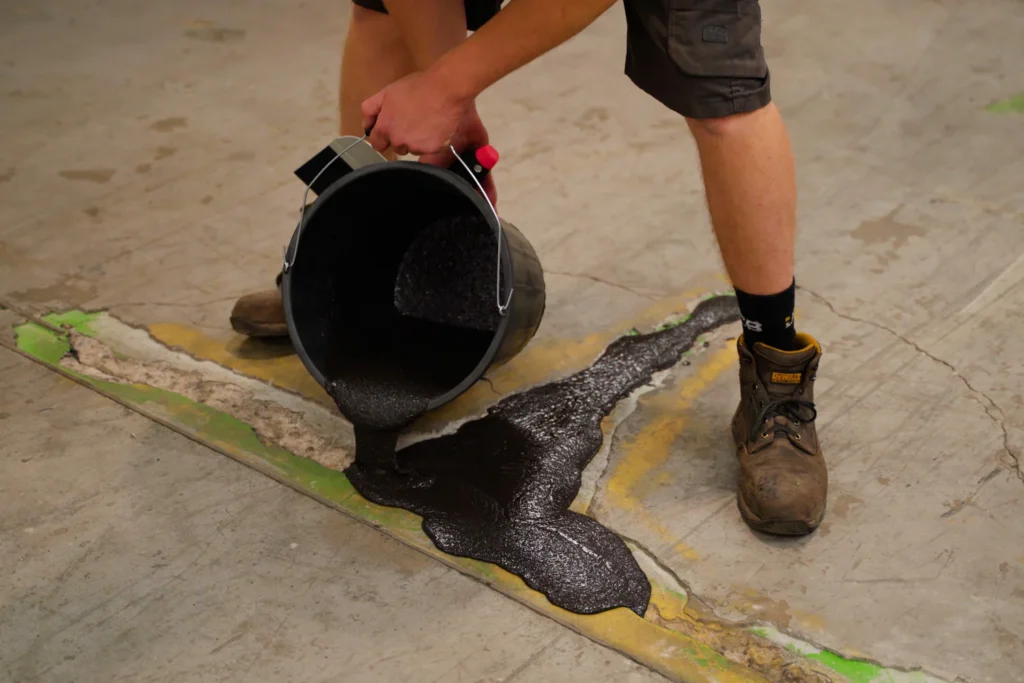
Removal is done chemically and slowly. Poultice strippers are applied, left to work, and taken back with low pressure rinsing, usually in test patches first so the effect on the surface can be judged before the whole facade is committed.
What must never happen is anything abrasive. Sandblasting removes the hardened outer skin of the sandstone along with the paint, and once that skin is gone the stone weathers many times faster. It is banned on landmarked buildings for exactly this reason, and it is a bad idea everywhere else.
Slow, controlled, tested in small areas first. Softens the coating so it can be removed without touching the stone underneath.
Strips the protective outer surface of the sandstone permanently. It looks clean for a season and then the facade deteriorates faster than before.
This is the part worth preparing for. Once the paint is off, a facade can turn out to be any of the following, often all on the same house:
None of these are reasons not to strip. They are reasons to open a test patch and see, before signing up for a full facade and a budget that is really a guess.
Removing paint, applying coatings and refinishing a facade all count as exterior work. In a designated district that needs Landmarks approval before anything starts, and the method matters as much as the outcome. We handle the filing as part of facade repair work.
If the stone under the paint has already spalled, or the coating is holding a fragile surface together, taking it all off can leave you with a facade that needs full rebuilding. In that situation the sensible plan is often to keep the surface covered, but to change what is covering it.
A breathable mineral coating lets vapour pass through while still protecting the face. It is not the romantic answer, and it does not give you bare stone, but it stops the freeze and thaw cycle that is doing the damage. Paired with proper waterproofing and restoration, it buys decades.
Thinking about stripping your facade? Start with a survey and a test patch. We will tell you what is under the paint before anyone quotes a full elevation, and if repainting is the better decision we will say so. Call (917) 297-7377 or email contact@brownstonerepairnyc.com.
